


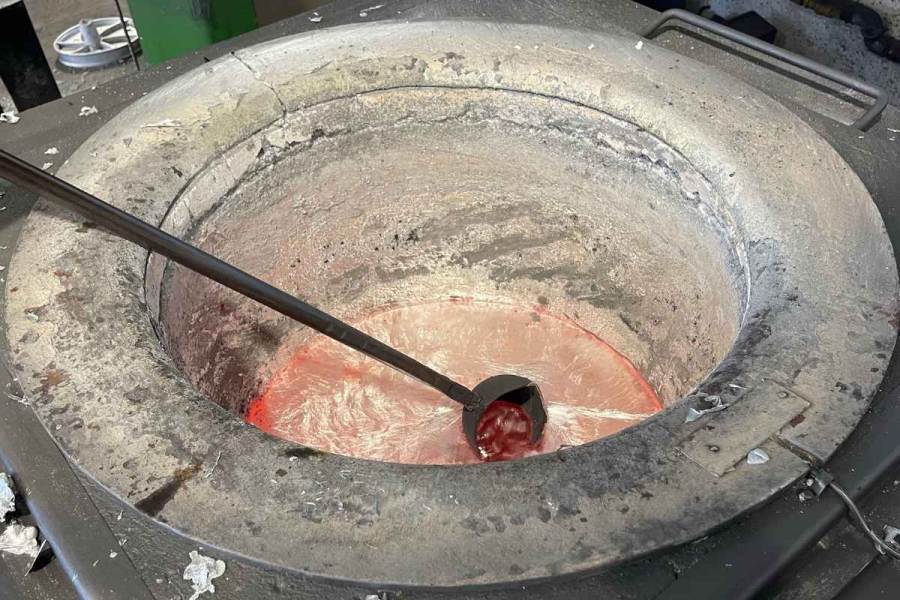
That amounts to more than 1.2 billion tonnes of material which, instead of being lost for good, continues to be part of products and applications.
The reason also lies in its high recyclability. Aluminium can be remelted and reused many times, while retaining its intrinsic properties. This is not only a matter of sustainability: it also has a concrete meaning in the mechanical industry, where aluminium is chosen to make numerous components designed to work inside machinery and transmission systems, including pulleys.
Recyclability and durability: two aspects of the same material
Returning to the initial figure, the most interesting characteristic of aluminium is that its story does not necessarily end when the product in which it was used reaches the end of its service life.
The International Aluminium Institute points out that aluminium’s intrinsic properties remain unchanged during recycling and that the material can be recycled repeatedly. It is precisely this possibility of having multiple lives that explains why such a large share of the aluminium produced throughout history is still present in economic and production systems.
From an energy standpoint, too, recovery plays an important role: according to the Institute’s data, in 2019 the production of recycled aluminium required 8.3 GJ per tonne, compared with 186 GJ for primary production, an estimated energy saving of 95.5%.
This does not mean that every aluminium product can be recycled automatically, or that the process involves no energy consumption or material losses. Rather, it means that the metal can remain within a production cycle for several generations of products.
In the case of aluminium pulleys, the concept fits into a supply chain that starts with the choice of material, passes through casting and machining, and ends with the use of the component within a transmission. A product’s durability and the possibility of recovering its material at the end of its service life are two distinct aspects, but both matter when considering a component’s life cycle.
Aluminium as a technical choice for Fipill pulleys
For Fipill, aluminium is not just a highly recyclable material. It is a raw material the company has worked with for years to produce components for mechanical transmissions.
Having an in-house foundry, together with lathes, machining centres and gear-cutting machines, makes it possible to oversee several stages of production and to develop both standard products and custom solutions. This is where the characteristics of the material meet production expertise: choosing aluminium means evaluating its properties in relation to the work the component will have to perform, while turning it into a pulley requires knowledge of casting processes, machining operations and the requirements of transmissions.
Aluminium, in short, can have many lives. But before it is recycled, it must be able to perform its first function well. And it is precisely in the design and production of the component that the choice of material becomes an integral part of the quality of the transmission. For Fipill, this means turning the characteristics of aluminium into components designed to work reliably within mechanical transmission systems.
FAQ
- How recyclable is aluminium?
Aluminium can be recycled repeatedly while retaining its intrinsic properties. According to the International Aluminium Institute, 74.5% of the primary aluminium produced from 1888 to 2021 is still in use. - Why is aluminium used for pulleys?
Its low density, machinability and the characteristics of its alloys make aluminium suitable for many applications in the production of pulleys and other components for mechanical transmissions. - Does recycled aluminium keep its properties?
Yes. Aluminium’s intrinsic properties do not change during the recycling process, allowing the material to be used again. - What types of aluminium pulleys does Fipill produce?
Fipill produces several types of aluminium pulleys, including V-belt, step pulleys, Poly-V, flat-belt and toothed pulleys, as well as solutions made to the customer’s specifications. - Does Fipill make aluminium pulleys to drawing?
Yes. Fipill has an in-house foundry and machining departments, and also produces custom components based on the customer’s specifications.